


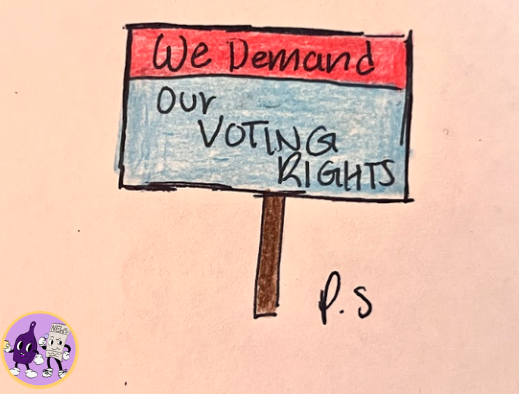
The U.S. Supreme Court narrowed a significant part of the Voting Rights Act in a 6-3 ruling last Wednesday, reducing the power of a major voting rights law. For decades, section two of the Voting Rights Act broadly outlawed discrimination in voting in bias of race.
The Voting Rights Act of 1965 was created to prevent discrimination in voting. The Act prohibits voting procedures that discriminate against race or color. Although the Constitution already said that people had the right to vote, many states used unfair tactics to stop certain groups from voting. Some of these methods included literacy tests, poll taxes, and threats. These practices mainly targeted Black voters and kept many from participating in elections. The Voting Rights Act made these practices illegal and gave the federal government power to enforce voting rights.
The act banned federal oversight, which is when federal examiners and observers draw district maps in a way where certain groups are discriminated against or cut out. The country is divided into voting districts by Congress and state legislators, and these districts are drawn on maps by state governments. Gerrymandering is when district maps are drawn in a way that gives one group more power. This is done by splitting up communities so that their vote is weaker and packing groups into one district so that they have less influence elsewhere.
In an executive order last week, Jeff Landry, the governor of Louisiana, declared a state emergency to postpone Louisiana’s active election, claiming that the Supreme Court’s 6-3 decision authorized an election emergency. The Supreme Court decided that Louisiana’s current congressional maps qualified as an unconstitutional gerrymander. This was based on the race of voters because it incorporated a second majority black district in the state.
After the Supreme Court’s decision, Landry claimed that the Louisiana legislature needed to redraw the state’s electoral maps for the midterm elections. Landry’s suspension has caused mass confusion amidst voters and political candidates. Because his order only applied to Congressional elections in Louisiana, other races are still ongoing.
In 2013, the Supreme court ruled in Shelby County v. Holder that a key part of the Voting Rights Acts was outdated. Shelby County argued that some states were treated unfairly based on old data from the 1960s and 1970s. In a 5-4 decision, the Supreme Court struck down section 4(b) of the Voting Rights Act. This section contained the formula that decided which states had to get federal approval before changing voting laws. Without the formula, section five couldn’t be used anymore.
The majority opinion was written by John Roberts, the court argued that the country hadn’t changed since 1965 and that the old formula did not reflect current conditions. The dissenting opinion was led by Ruth Bader Ginsburg. They argued that discrimination in voting still exists and removing preclearance was risky. Congress had also reviewed and renewed the law and they didn’t think change was necessary or helpful.
The outcome of this decision was that states that were previously monitored could change voting laws without federal approval. Quickly after, some states passed laws like voter ID requirements, redrawing district maps and changes to voting hours. The case did not fully eliminate the Voting Rights Act, however, it did weaken it and shifted its power back to the states.
The Brnovich supreme court case of 2021 involved a challenge under section two of the Voting Rights Act to two Arizona voting policies. First, the obligation of voters living in Arizona counties who vote in person to cast their ballots in their neighborhood electoral district rather than another polling location. The second is the prohibition on a voter’s completed ballot to be mailed or delivered to anyone other than the voter. The argument of this case was that these rules had the effect of discriminating against race which violates section two of the Voting Rights Act.
The high court’s decision is the outcome of a long running battle in Louisiana over Black Voters representation in congress. The Supreme Court first heard the argument in the case in March 2025, but the justices failed to issue a ruling and made an unusual decision to hear it again in this term. In the October rehearing, the justices asked broad questions around the Voting Rights Act as well as its fulfillment. This hinted at the fact they wanted to change the act because they didn’t think it was beneficial.
Louisiana putting a pause to their elections right as the Voting rights act was changed has caused conspiracy and confusion among voters. Florida, North Carolina, California and Utah are only some of the states that are also redrawing their electoral maps. With the dismantling of the Voting Rights Act, we could see unfair and biased elections with secret intentions covered by excuses.