



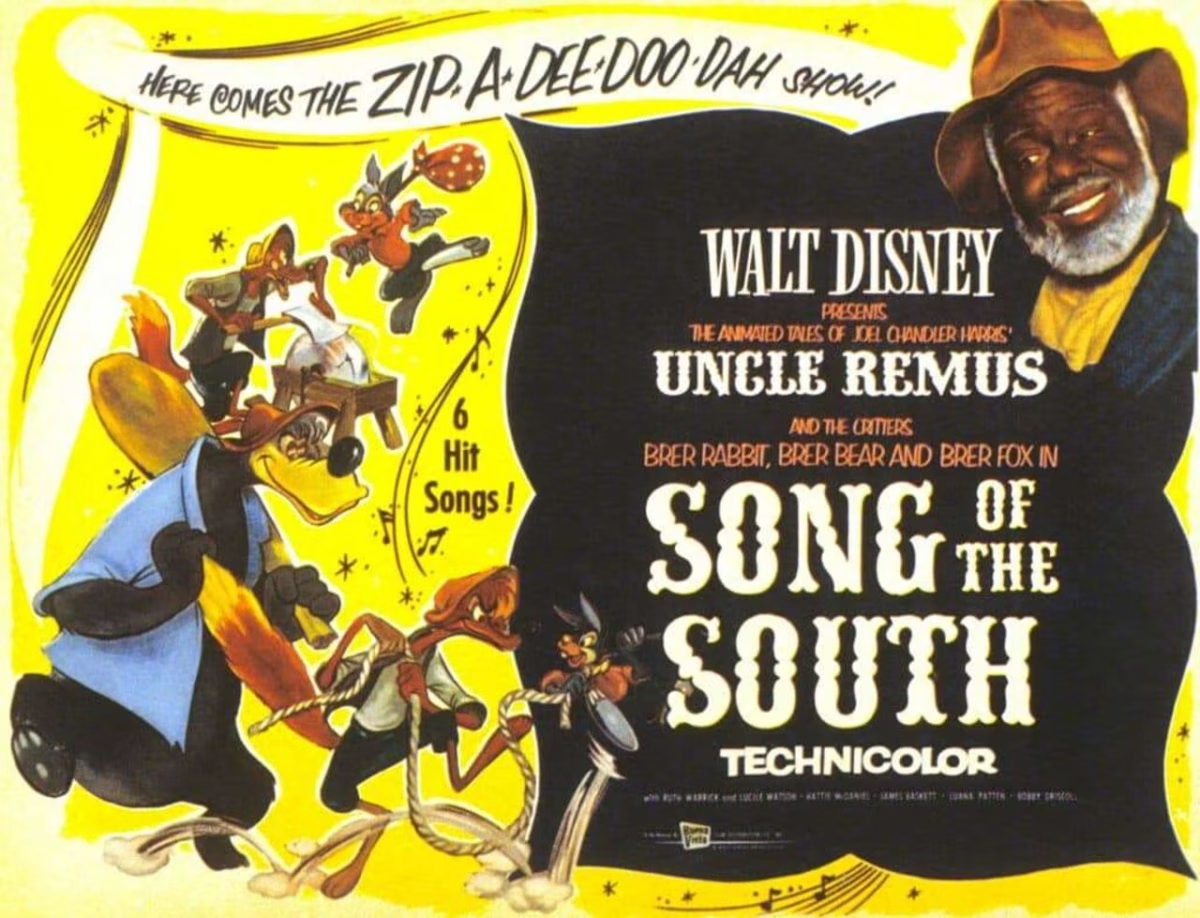
(NOTICE: THIS ARTICLE CONTAINS SPOILERS FOR SONG OF THE SOUTH)
February is Black History Month, and with that comes two things: acknowledging those that fought during the civil rights movement to get us to where we are today, and recognizing the wrongdoings of the past so we can learn from our mistakes. The latter is our focus today.
Walt Disney is a name many are familiar with. By combining the two blossoming industries of film and animation, he was able to successfully create stories for many to enjoy. In 1938, Disney’s interest sparked towards The Uncle Remus (Ree-mus) stories, which he claims to have enjoyed as a child.
The Uncle Remus stories are a collection of seven books consisting of several short stories that were released from 1881 to 1907 by Joel Chandler Harris. These stories were adapted from folktales he had heard during his stay at a plantation. These stories often included the African folklore characters of Br’er (brother) Rabbit, Br’er Fox, and Br’er Bear, with the latter two being antagonists. Harris wrote these stories in an extremely stereotypical black dialect, in hopes to preserve their originality. At the time, he was praised for this.
Disney began wondering about the possibilities of creating an adaptation of these stories, and in 1939, he purchased the rights to them for $10,000 (about $223,000 when adjusted for inflation). After discussion, the film was decided to be one third animation, with the rest being live action. Disney also sought out a professional screenwriter, eventually hiring the writer Dalton Reymond. If I were to pinpoint one of the key factors in what makes this movie so controversial in recent years, it would be this man.
Dalton Reymond was a white Southerner who had some questionable decisions on the film’s direction. Reymond frequently used terminology in his outline that had to be removed, such as referring to Uncle Remus as an “Old Darkie”. An African American writer named Clarence Muse was hired to assist in the screenwriting, but quit shortly after his requests to Reymond to dignify the film’s black characters were denied in favor of the more stereotypical depictions. On top of this, Reymond had no experience writing for films prior to this. Because of Disney’s fear of the direction the movie was taking, writer Maurice Rapt was hired to assist Reymond. As an adamant leftist, Rapt helped change the script immensely.
Once the script was done, the rest of production, casting, and filming took place. Song of the South premiered in November of 1946 in Atlanta. Ironically, James Baskett, the actor for the lead role of Uncle Remus, was not allowed to see the film’s premier due to the segregation laws in Atlanta at the time.
Song of the South involves a young boy named Johnny visiting his grandmother’s plantation alongside his father and mother. The film takes place in the deep south of Georgia during the reconstruction period, when slavery had been abolished. His father announces that he will be leaving for Atlanta due to complications with his job, and Johnny is understandably upset. He plans to run away to Atlanta in the later hours, but on his way out he hears an elderly man named Uncle Remus telling stories about a character named Br’er Rabbit to his fellow plantation workers. Uncle Remus notices Johnny and tells him the story. The story involves Br’er Rabbit leaving his home, but after an encounter with the notorious Br’er Fox and Br’er Bear, he quickly regrets it.
Johnny is so moved by Uncle Remus’ story that he decides to stay. He makes friends with a black boy named Toby and a young white girl named Ginny. However, Sally, Johnny’s mother, does not want Johnny to keep the dog, so he offers it to Uncle Remus for safe keeping who accepts and tells Johnny another story, this time based on the story Br’er Rabbit and the Tar Baby.
Johnny demonstrates the tactic used by Br’er Rabbit in the most recent story, urging the boys to “tell anyone except their mom” about his hiding the dog. They end up telling their mom, who gets them in trouble. Thirsty for revenge, the boys tell Sally about the dog, which causes her to tell Uncle Remus that his stories are a bad influence on her son and to watch himself.
Johnny’s birthday party comes around, and he goes to Ginny’s house to walk her to the party. However, they are yet again encountered by her older brothers, who shove Ginny into the mud, making her dress dirty. Seeing this, Johnny attacks the taller of the two brothers. Uncle Remus, seeing the situation while passing by, breaks up the fight, shoos off the two brothers, and tells the story of Br’er Rabbit and his “Laughing Place” to try and cheer up Johnny and Ginny.
After Uncle Remus finishes telling the story, they return to the party, which has ended. Sally is angry with him and asks him why he missed the party. Johnny explains that he was hearing the story of the laughing place and learning about its applicability to himself. Furious with Uncle Remus, Sally orders him to stay away from her child. Uncle Remus, saddened and confused by the outcome of his actions, begins to pack his things and leave the plantation for Atlanta.
The next morning, Johnny sees Uncle Remus leaving the plantation. Determined to reach him in time, he cuts through a bull pasture, which ends up getting him seriously injured. While Johnny is laying in a bed struggling for survival, he asks to bring in Uncle Remus. He arrives and begins to tell a Br’er Rabbit story, miraculously saving Johnny’s life.
Johnny, Ginny, and Toby begin to walk to their “laughing place”. Uncle Remus, shocked to see an animated Br’er Rabbit among other creatures joining them on their walk, comes along as well. The movie ends with all of them walking into the sunset while singing “Zip-a-dee-doo-da”, the movie’s most iconic song.
This movie surprised me. I will come forward and say that this is, in terms of movie structure, a good movie. The pacing is near-perfect, with no scenes lingering on for too long but not feeling quick or unfinished either. The actors are giving great performances pretty much all around. The animated sequences are flowing and colorful, affirming the public’s opinion on Disney’s hand-drawn 2D animation. But of course, if this was all the movie was, it wouldn’t have nearly the reputation that it has today.
Firstly, the voices for the animated sequences of Br’er Rabbit, Br’er Fox, and Br’er Bear are extremely stereotypical depictions of black people, and even though they were all voiced by African American actors, knowing some of the practices that went on with Dalton Reymond during production, and I doubt they chose this on their own accord.
The second thing that needs to be brought up is the expression found in Uncle Remus. When he is on screen, he is almost always extremely wide-eyed and smiling. While this in itself is not a problem, the way this is used to promote certain ideas causes trouble.
The runner up for the worst thing about this movie is the lighting. Oftentimes, the lighting is sort of split diagonally, with about a third of the screen calmly lit and the rest of it being almost completely dark. Uncle Remus is almost always seated in this dark two-thirds of the screen. If this wasn’t enough, factor in his aforementioned expressions, which cause only his wide eyes and smiling teeth to be visible throughout the sequence. It’s like they’re trying to convey that he is kind and caring, while also having the scene lit like a horror movie to indirectly scare the audience.
That leads us to Song of the South’s biggest issue: the morals and themes. Whenever the other sharecroppers are shown, they are joyful, either listening attentively to Uncle Remus or singing happily, when in reality, sharecroppers were still treated extremely poorly during this period. Most of the messages, however, are again conveyed through Uncle Remus. He doesn’t mention any unfair treatment, but only his stories that bring him joy and how much he loves working on a plantation. Combined with the joyful expressiveness that was already mentioned, this is what gives the movie its pro-slavery message that has prevented it from being available to the public.
Even after watching Song of the South, my opinion of it is still conflicting. On one hand, the movie is structured well with some beautifully animated portions that were enjoyable to watch. And on the other hand, any positive message that could have been conveyed is lost and instead replaced with the idea that plantation work had a positive effect on its workers. It’s not easy to simply separate these two things and analyze them separately because they directly connect with each other. The story was structured around the theme of pro-slavery, even if it is well structured. And no amount of good movie making can counteract racially motivated themes.
My honest advice for those who wonder about Song of the South is to watch it themselves. I went in not expecting anything worth of value, and I came out of it surprised. Song of the South is an anomaly of past views and truly makes the viewer think about what they are watching, and that is why it should be viewed by those who desire to.
