



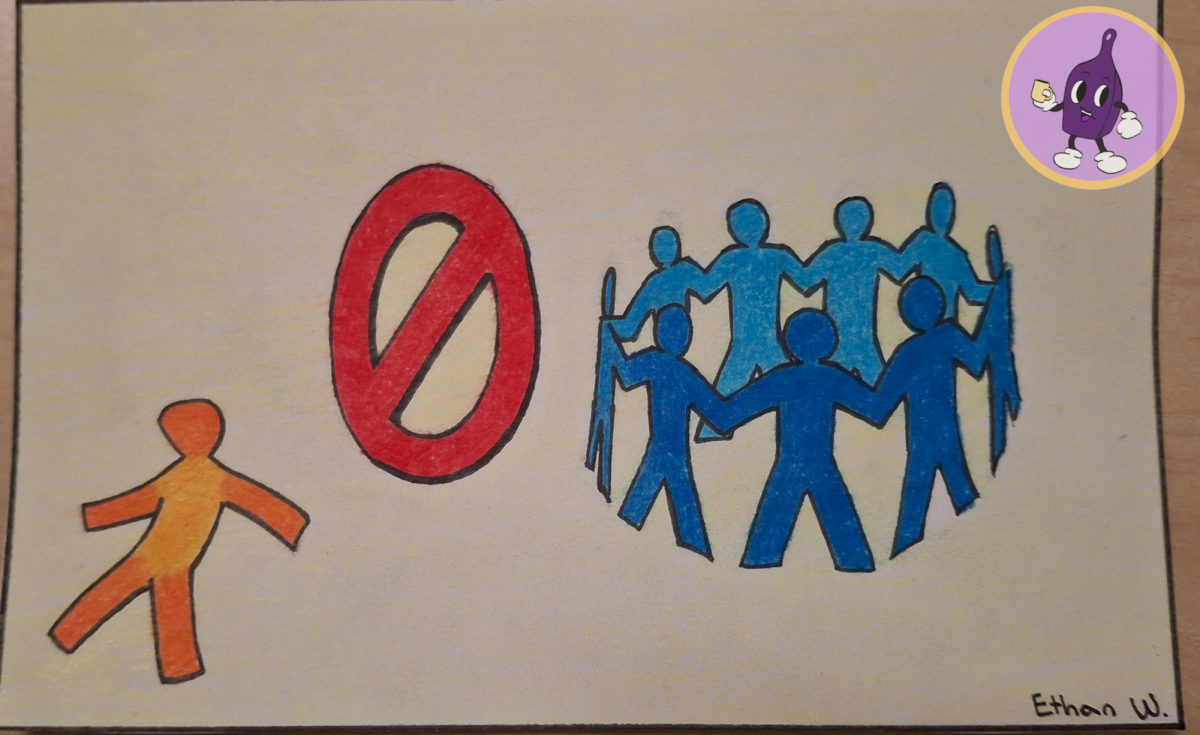
Discrimination against people of different races, genders, abilities, and many other factors have been highly prevalent since the creation of the United States and by association, the U.S. education system.
There are various types of discrimination that can be seen in nearly all schools around the country in both societal aspects of the environment and the curriculums themselves. High school is typically a time that students become more cemented in their own thoughts and opinions, making it a great opportunity to observe the interactions between peers, educators, and the systems around them.
Schooling in each state differs from one another, meaning that the curriculum and the social environments are different as well. In Montana, many of the forms of discrimination are the same as most of the country; however, more than 80% of Montana is still occupied primarily by white citizens.
One of the state’s most prominent minority groups is its Native American population.
Montana enacted a constitutional provision in 1972 due to strong indignation from Native American communities to make services necessitating that public schools across the state would provide “Indian education” to all grade levels, subjects, and curriculums.
It wasn’t until 1999 that the state Legislature passed the Indian Education for All Act (IEFA), an act intended to keep the constitutional promise from 27 years earlier.
Twenty-two years later, in 2021, the American Civil Liberties Union (ACLU) sued the state of Montana for not properly adhering to its legal obligation to administer an education that sufficiently covers the topics of Native American history and culture.
This can be especially problematic in a state that has numerous tribal nations and an 6-8% Native American population, making it the largest minority in the state.
Across Montana, advancements have been made in order to adhere to a system that highlights Native Americans history throughout the country. Individual schools and teachers may not follow IEFA programs exactly the same due to personal teaching styles and curriculums, but as a whole, the state has shown improvement in these policies.
At Sentinel High School (SHS), the IEFA program is most frequently taught in English and History classes: featuring novels such as Killers of the Flower Moon by David Grann, and Native American, member of the Spokane tribe, author Sherman Alexie.
While Native Americans are the largest non-white members of the Montanan population, many people of other races and ethnicities reside in the state and nearly all of them face some level of racial discrimination.
Racism has been a strongly visible factor of prejudice in the country since its foundation. Schools are no different.
Black citizens were not allowed to learn how to read or write for more than one hundred years before, during, and even shortly after the Civil War. In 1964, the Civil Rights Act passed which prohibited discrimination based on race in many environments. However, it wasn’t until ten years later that the government passed the Equal Educational Opportunities Act, forbidding intentional segregation concerning race, ethnicity, or country of origin in schools.
Despite this act being passed, most schools to this day are still racially and ethnically separated, with most white students attending schools that have less than 25% of students that are people of color. Many places have been known as “white neighborhoods” or “Black neighborhoods”, due to districting this segregates schools as well.

Modern public school districts in much of the United States are zoned based on the neighborhoods that surround the school buildings themselves. This means that local taxpayers fund most of their regional school’s amenities.
Consequently, poorer neighborhoods tend to have less materials in their lessons and schools due to the scarcity of finances in the districts. Black and Hispanic families in the USA are 3.5 times more likely to be located in underfunded districts, giving them less accommodating education than many students in the United States.
All schools, including Sentinel, have students who are unhoused, living in financially unstable situations, or have mental or physical health problems that impair their learning. SHS social worker Tara Ferranti notes that the campus has “pathways in the building for all those things […] the part that can be a little sticky for [Sentinel’s] families is when they don’t know how to ask for help.”
Multiple studies by the American Sociological Association on the connections between students with highly educated families and students without have been done.These studies show that less educated families tend to have lower financial stability and the children of those families have higher rates of stress due to the uncertainty of funds.
In addition, schools with higher socioeconomic standing tend to receive more government grants and financial donations from the community. Schools that are largely populated by lower class students don’t receive the financial support that the school needs to provide the proper amount of care for their studies.
Ferranti, along with fellow social worker Sarah Kragelund, regularly communicate with families to combat these issues. One of the biggest struggles they have in assisting is not knowing which students are in need of help.
Another area in which administrators are brought in to assist students is for students who are not fluent in the English language.
Missoula County Public Schools’ (MCPS) Aria Peters, the High School English Language Learner (ELL) administrator works with students who do not understand English to the degree necessary for high school studies but who are fully capable in all other respects. MCPS’ ELL structure is very broad, leaving room for the administration to create lessons that will properly accommodate the students under their care at any given time and any knowledge level.
Peters stated that she did not notice much oppression from teachers and administration. However, she has seen what she hopes is unintentional discrimination. “it is especially important for staff to constantly be reflecting on biases and assumptions.”
Students in all additional learning structures have often been treated as lesser-than, with terms like “SPED” being thrown around as insults in the halls. Whether or not these insults are directed towards students in need of these accommodations, it can have the same negative effect.
While students treat each other with discrimination under Title ll of the Americans with Disabilities Act of 1990 the schools are required to treat them all equally. No individual with disabilities shall be excluded from participation or benefits of services, programs, and activities based on their disability.
All public schools are required to follow these plans under the ADA. Private schools that are federally funded, will often be obligated to follow and provide 504s and IEPs under the ADA. However, if they are privately funded the schools may provide as much as they desire.
While misogyny has been less of an issue in recent years it is still notable in society. Women have been treated as nearly equal in education settings throughout much of the United States. However, in 2023 due to the political struggle over reproductive rights, the slogan “Your body, my choice” became present in all aspects of life. In schools, it became not only a slogan but in some cases a violent attack with girls being pushed into lockers while boys say harmful phrases to them.
Women are often underrepresented in educational settings. In the curriculum itself, men’s accomplishments in science, history, and mathematics are often highlighted while women’s go overshadowed or completely ignored.
This has an increasingly negative effect on young women; representation gives them the hope and resolution to work for a place in history.
The phrase “boys will be boys” is still being thrown around in educational settings, placing young girls on a higher standard than their male counterparts. The political, social, and economic situations throughout the country affect every aspect within it. Students still have to face these struggles when in school and it can either harm or help them
Many schools, including SHS, have made efforts to not only help to avoid issues but also face them head on. By putting women in more positions of power within the school, Sentinel High School has had at least one female student body president for at least four years and has advocated for girls in non-traditional areas of study such as STEM (Science, Technology, Engineering, and Mathematics) classes.