


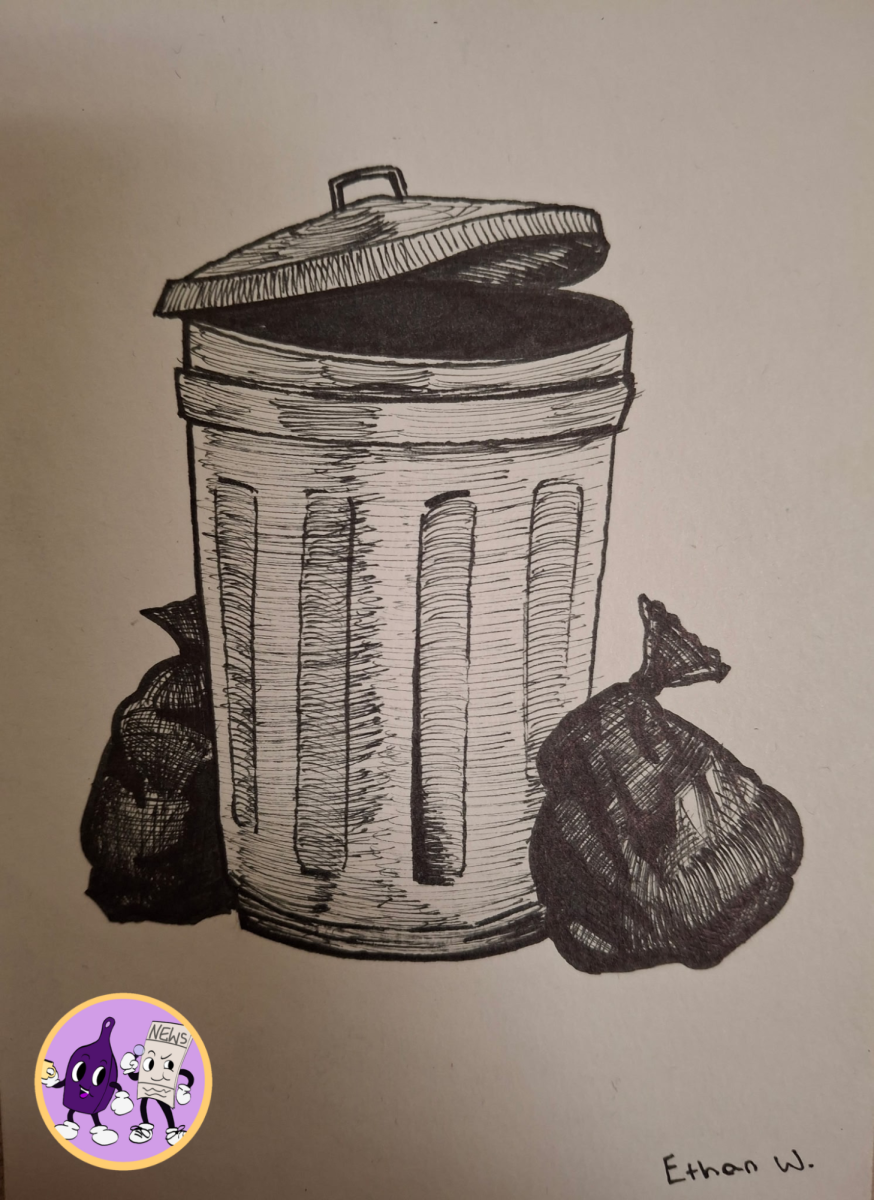
Principal Thennis has removed the two spherical trash cans that were at the of the school on either side of the entry walkway in front of the crosswalk. From her office, she would see birds grab trash out of the trash can, put it on the ground and eat it, showing how the trash cans contributed to the litter on campus, rather than serving their purpose.
Very few trash cans allow pizza boxes to fit inside of them which causes the trash cans to look full when they actually have a lot of room. The dumpsters, on the other hand, are able to fit the pizza boxes as well as the everyday trash from around the school.
When looking around Sentinel’s campus, many will find that there is a big problem: Trash. Trash around campus is not a new issue, but now, thanks to Sentinel Principal Stephanie Tennis, there are steps being taken to solve this problem. It all started a little over a month ago when Mrs. Thennis was picking up her son from practice at Sentinel and noticed that the empty Senior Parking Lot was worse than she imagined.
According to Thennis, the student parking lots are the worst of the areas on campus. If a staff member sees a student littering, a consequence will follow; however, this is inconsistent and doesn’t happen if a staff member isn’t there at the exact time that an infraction occurs. Tracking students over the cameras is unrealistic because students arrive on campus at many different times throughout the day.
During the 2024-2025 school year, Mrs. Thennis encouraged clubs and classes to go outside during their SPEAR period to pick up trash; this strategy worked so well she decided to implement the program again this year. This year classes and clubs are not only encouraged to go out around campus during SPEAR, but also to go out during their classes if their teachers sign up on a collective Google Sheet document to which all SHS staff members have editing access.
This long term project is similar to the most recent Sentinel transformational learning project dealing with planting trees around campus and creating a unified goal for students to become involved in the preservation and aesthetics of the Sentinel campus.
Asking classes and clubs to participate is just one of many programs that Thennis is implementing to handle the trash problem on campus. Thennis has also installed a couple of additional dumpsters around campus in the problem areas (including the senior lot, behind the gym, next to the auto shop, outside the woodshop, and in the bus loop). The hope for these dumpsters is that students will, instead of dumping their trash wherever it’s convenient, dispose of their refuse in the giant dumpster that is in front of them.
An eventual solution for the massive problem of trash on campus will involve students creating something to help. Mrs. Thennis’s idea is both the welding and the woodshop classes creating a large specialty trash can that could be easier for students to use. She has worked with students and staff to create this design and is very proud to see it come to fruition in the near future.
According to a study from Coca-Cola Enterprises and Keep Britain Tidy, young people, defined as people under the age of 25, are more likely to litter soft drinks than anything else. The same study also found that education and campaigns to stop littering are very ineffective when trying to prevent it.
The influence that is highly effective over everything else was social influence. When young people see their friends throwing their trash away, they tend to throw their trash away. This works in the opposite direction as well, when young people see their friends littering they do as well.
Social influence applies even if the people around when littering are unknown. If it is crowded in the parking lot or the area people are more likely to not litter because they fear they are going to be judged. The final studied behavior that was tracked in the study was whether the environment that young people are in affects their likelihood of littering. The answer to this question was a resounding yes. When young people care about the environment in which they would possibly litter, they are less likely to litter.
The time between students parking and their next activity, such as a class, affects how much and when they litter. If students are running late for a class, they are more likely to just set their trash down in the spot they parked and run into the building. That is why the dumpsters have been placed in “convenient” spots for students to drop their trash as they are walking (or running) into the building.
Trash outside is not the only trash issue on campus. Inside janitors spend hours every day picking up trash that students decided to throw on the ground or leave on their desks in class. This is particularly apparent in the class periods after lunch, when students leave their trash in the common areas and in the various lunch spots that students eat in.
Trash being present on and off campus is an issue that affects everyone. Now with these new programs that have been implemented, a beautiful campus is within reach.